For Ben Chitiyo, it’s always been cricket. His love affair began in Harare, the capital of Zimbabwe, and continues today, in East London.
The 57-year-old holds a deep, lifelong passion for the game, so it’s absurd to learn that it took him until 2021 to complete professional coaching qualifications.
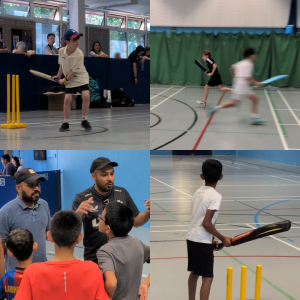
But he’s made up for the lost time, dedicating hours to coaching at three Chance to Shine Street clubs in Essex, which help young people living in the area have access to the game.
“I imagine the children who experience what I experienced with my parents. I was restricted as a child growing up, and I don’t want the same thing to happen with them. That’s why I became a coach.”
His relationship with cricket has never been smooth sailing. Growing up in 1970s Zimbabwe, Ben’s parents’ approach to sport was stifling. A vague resemblance of the feud between the Montagues and Capulets comes to mind.
“Sport wasn’t valued by my parents; it was a no-go. You had to be academic, but it wasn’t for me,” said Ben. “I loved cricket, so I sneaked off to go and play. I’d get in trouble sometimes.”
“My mum sacrificed a lot of money for me to go to that school. She was determined I received an excellent education.”
Conversely, the school in question, Blakiston Junior School, was the only avenue for Ben to play organised cricket. “If it wasn’t for my mum, I would not have known cricket, even if she sent me to Blakiston for different reasons. I’ll always be grateful to her.”
His potential was first spotted by PE teacher, Miss Penney. “She saw me playing in the playground and saw my athletic ability,” explains Ben.
“She wrote to my parents telling them I should play for school. It took a lot of convincing, but eventually they agreed.”
Ben played in one of the year groups below Miss Penney’s son, Trevor, who went on to represent Warwickshire from 1986 to 2003, and played as a substitute fielder for England during the 2005 Ashes.
He was a figure Ben aspired to emulate. “Trevor was an outstanding sports person at school, so I just wanted to be like him. And I had the ability, I succeeded.”

Unfortunately, his post-primary years were the start of a long hiatus away from the game. At senior school he stopped playing, before moving to the UK in 1989. At this point, attention shifted away from cricket and towards accounting qualifications, along with part-time work to support family back home.
He had his son, Ben Jr, in 2005, and daughter, Kizzy, three years later. His marriage broke down a year later, in 2009, and he took full custody of his children.
“After telling my kids how I loved cricket in primary school, I gradually returned,” he explains. “We ended up going to the park every Saturday, they would come with their friends. They loved it.
“But we’d do different sports too. We played tennis, basketball, football. I wanted to make sure they grew up differently to me. I wasn’t going to tell the kids that they can only focus on academia, so I introduced them to everything.”
The result is two children sport obsessed and focusing on basketball and rugby. “They still love cricket, they’ll come back, and we still play together sometimes,” said Ben. “It’s all about choice; if they’re passionate about basketball I’m not going to take that away from them.”
After reconnecting with his high school sweetheart from 1984, Ben realised his ambition to work in cricket, with her support. He joined Newham Cricket Club in 2018, where he continues to play for the fourth team, and graduated in Sports Science from the University of East London in 2021.
Alongside this, he completed coaching qualifications and became a level two coach that same year. “I wanted to learn more and more every year,” said Ben. “I always strive to update myself, to try and improve, so I can help a young kid who’s passionate, but doesn’t have much support.”
Now, he coaches at Chance to Shine’s Jo Richardson Street Club in Dagenham – the 5th most deprived local authority in the UK – alongside coaching at clubs in Redbridge and Newham.
50% of the children he coaches in Dagenham are from a Pakistani background, and a further 25% are from other Asian ethnic backgrounds.
Ben explains: “Afro-Caribbean young people don’t think cricket is for them, perhaps because they see that most cricket players in the area are Asian, and don’t see many black players on the television and in the media.
“If there can be enough black role models to show how fun cricket can be it would be brilliant, to encourage more of them to play.”
It’s an issue faced not only in East London, but nationally. According to a 2020 report by Sport England, young black people were considered as significantly under-represented in cricket, across the country. Throughout the cricketing community, the next step is to improve participation amongst young black people throughout the UK.
By facilitating safe spaces for young people at Street clubs like the Jo Richardson, Chance to Shine’s coaches provide young people, whatever their background, the opportunity to learn, develop, build resilience and confidence, by playing cricket.
These are skills Ben strives to teach among young people on a daily basis, with striking rewards.
“If you give them an environment where they can just have fun and appreciate failure, they learn that failure is part of a life. I encourage them to have a go and remind them that it doesn’t matter if they fail.
“One of the boys I coached went on a journey. He didn’t know cricket at all and was so shy that he wouldn’t even speak. Now, he’s developed so much, and he’s got so many friends from playing.
“There’s no better feeling than seeing a child who thinks cricket is not for them transform into a confident player.
“His parents have written to me saying thank you. Money can’t buy that feeling.”
—
Click here to learn more about our Street cricket clubs
—
To celebrate Black History Month, Chance to Shine are celebrating members of the black community who epitomise our mission.
We’re excited to share their stories, to highlight how they have created positive change and helped forge a more equitable future for everyone, in line with this year’s theme, power and pride.